A selection of some works
from the archive
PARALLEL
PRAYERS
Last updated Nov. 2025
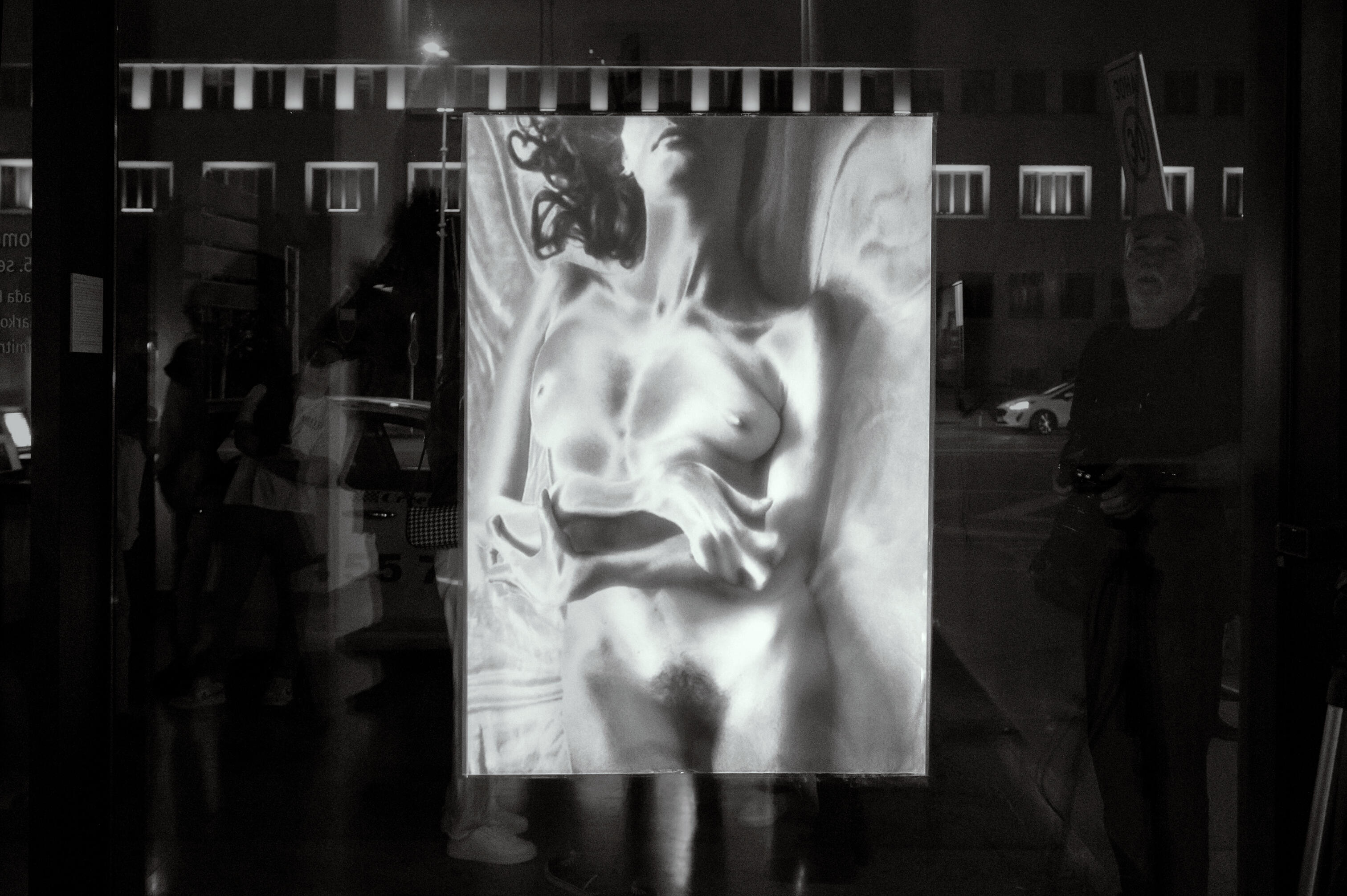
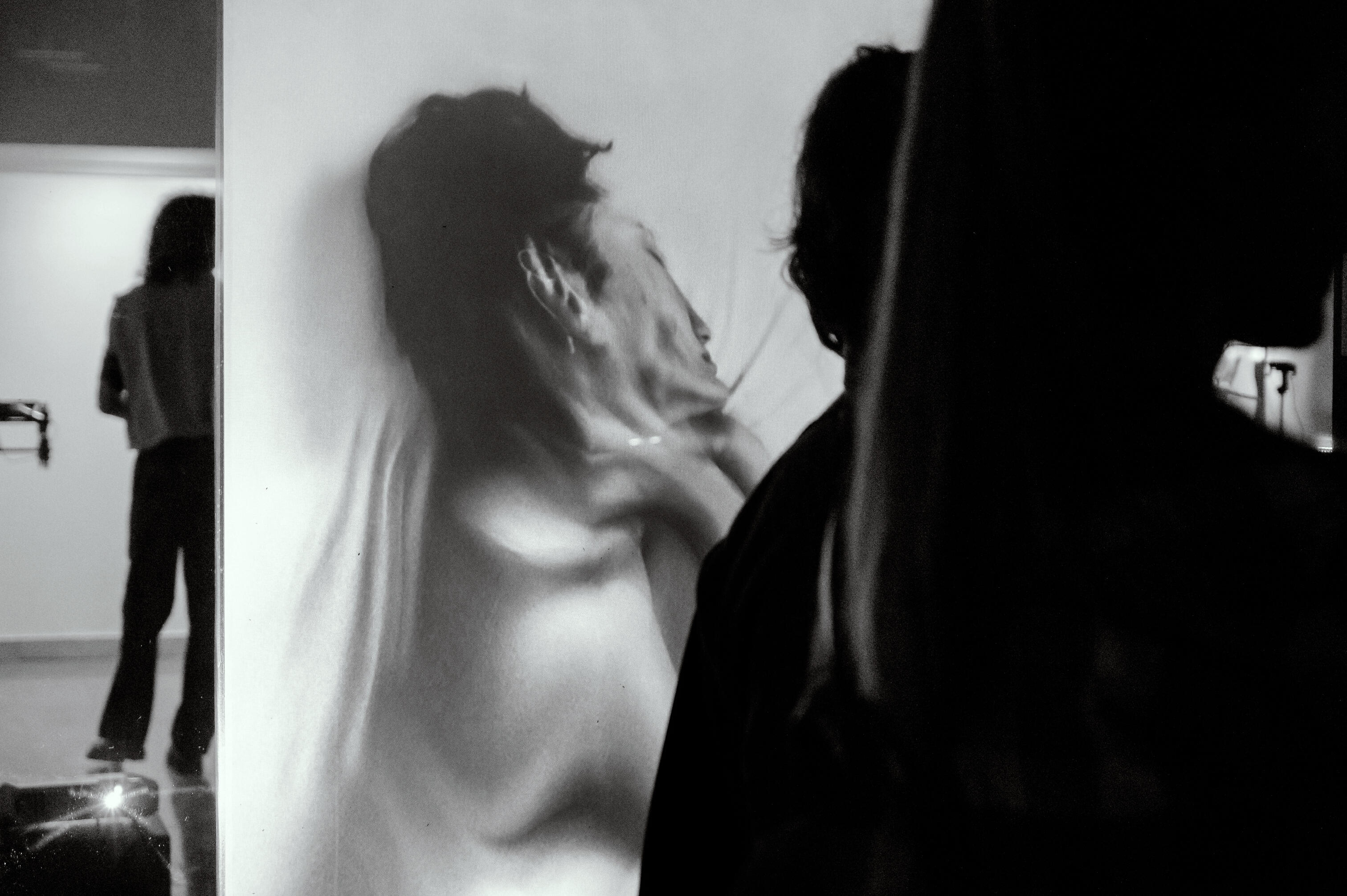
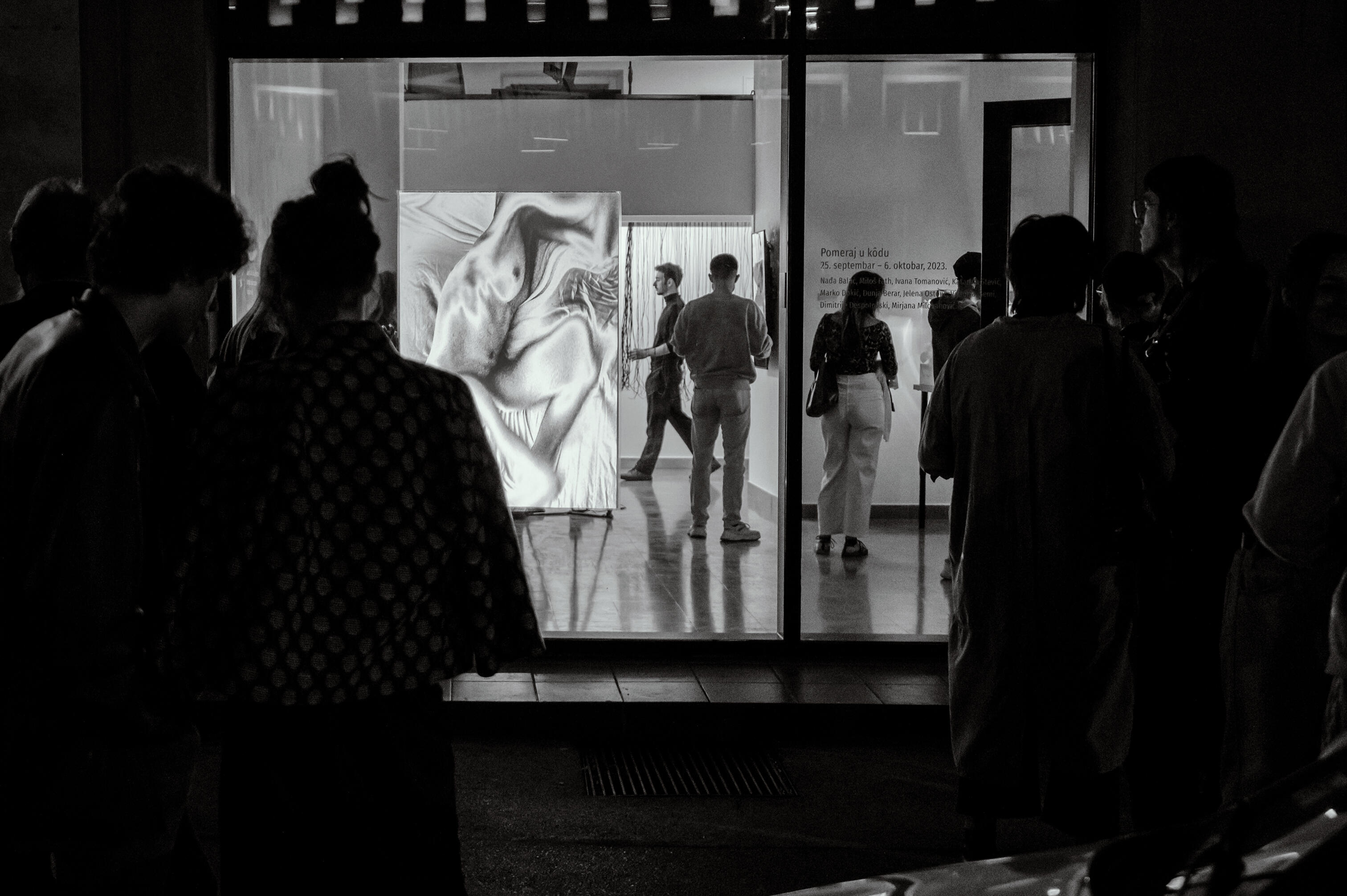
Thirty solarized analogue photographs of a female nude projected onto a gallery window as a sensor tracks the movement of passersby. Each body that crosses the frame triggers a manipulation: the nude bends, distorts, fractures as her skin stops fitting right.This is a work about the body becoming foreign territory, the particular violence of being seen—how the external gaze enters and rearranges what it finds. The installation operates between midnight and dawn: the hours when perception loosens, when the distance between self, reflection and projection stretches thin. The public, walking past, may not know they are participants. They do not need to, as the work functions the way scrutiny does: without consent.The solarized image—a photographic process that inverts and destabilizes—mirrors a body caught between presence and dissolution. Analogue, the grain is visible. The body remains a body, even as it warps. The window is both screen and membrane, between two spaces. The nude exists in the threshold.
Ivana Brezovac was born in 1971 in Novi Sad. She holds a master’s degree from the Academy of Film and Television (FAMU) in Prague – Department of Photography. Currently is studying for a doctorate in the field of fine arts at the Academy of Arts in Novi Sad. From 2001 to 2015, she worked as an editor in the magazine for the culture of photography – ReFoto (Belgrade). As a full professor, teaches photography at the Academy of Arts, University of Novi Sad. She was the artistic director of the Artget Gallery, Cultural Center of Belgrade for the 2016 season. Regularly lectures on the estethics of photography and is a participant in numerous panel discussions at festivals, workshops and congresses dedicated to photography and visual arts.So far, Ivana has published over three hundred articles in Refoto magazine, exhibition catalogs, books, magazines, newspapers… Has judged numerous exhibitions in the country and abroad and was a member of the board of the Photography Fair organized by the Artget Gallery and the Belgrade Cultural Center as well as member of the national selection team at the Rovinj-Photodays festival. She was the representative of Serbia in the European project “Transeurope” dedicated to European contemporary photography, organized by the Finnish Museum of Photography (Helsinki), PhotoEspana (Madrid) and Euromare (Athens).Her photographic work is mostly dedicated to subjective research work in the field of documentary photography and staging, and she is especially interested in the possibilities of installing artwork in space.
INSTALLATION WITH IVANA BREZOVAC
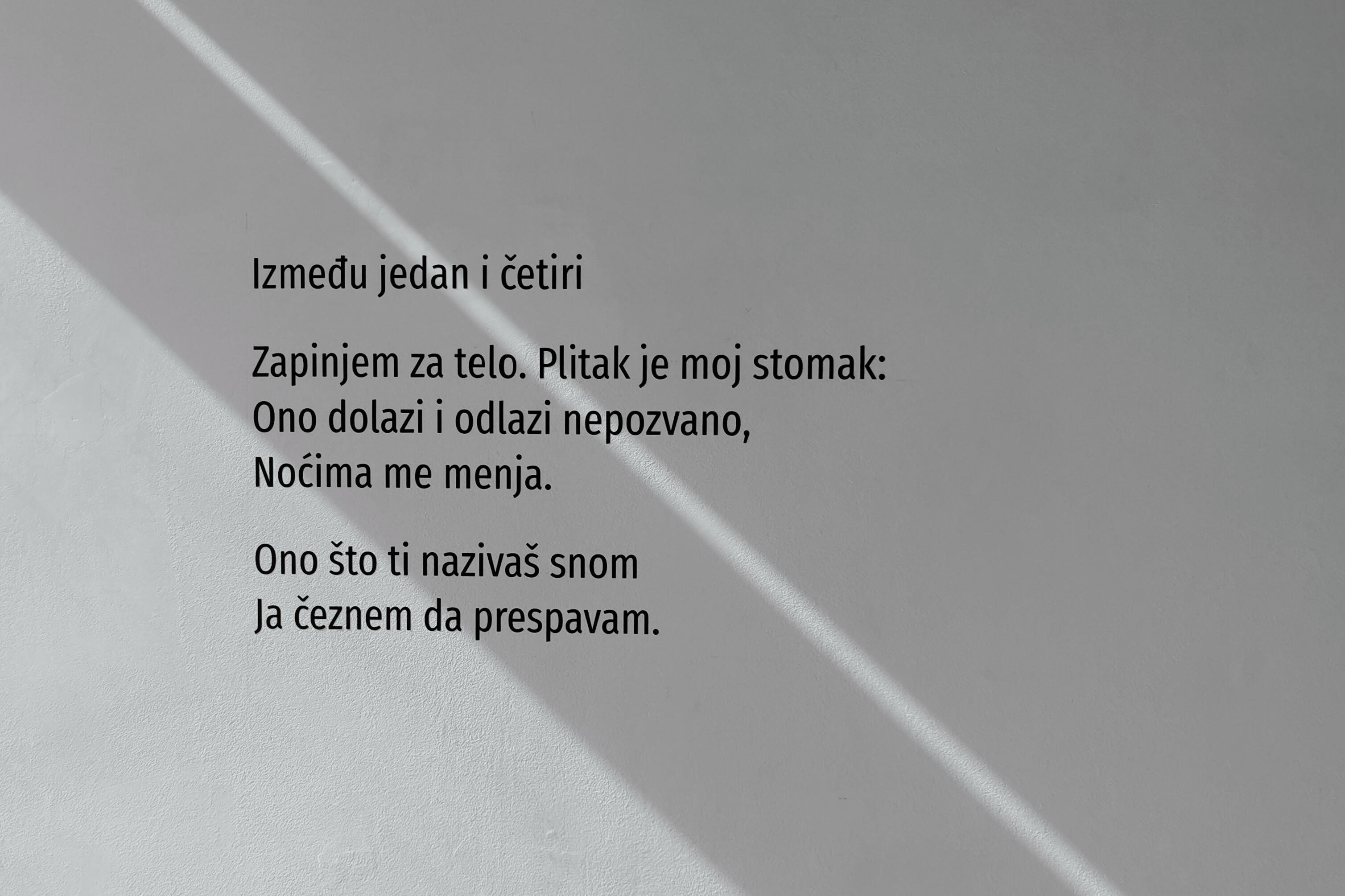
Insomnia
Co-created with Ivana Brezovac2023
Interactive installation, 30 analogue solarized photographs
Variable dimensions
* * *
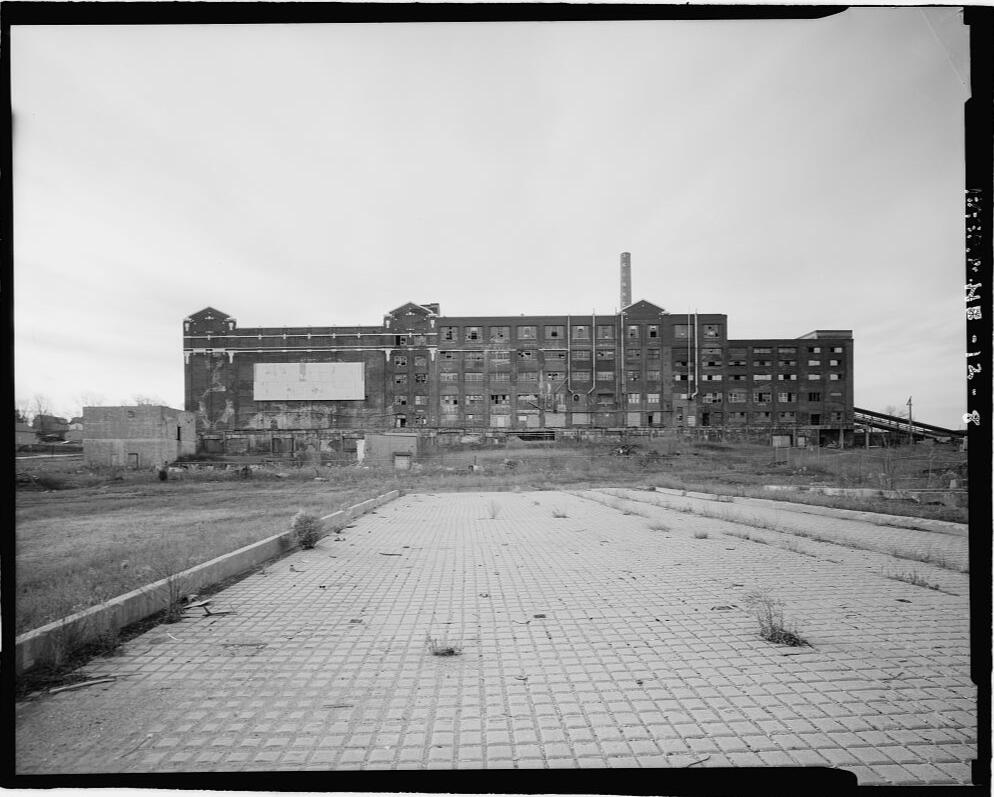
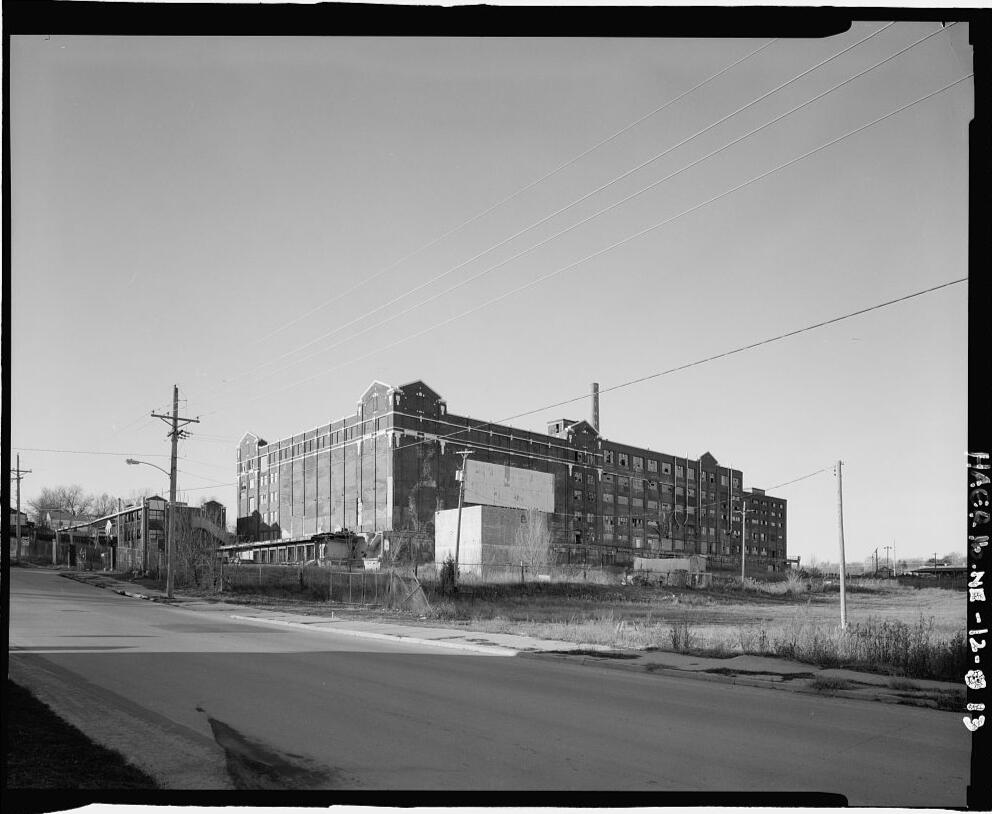
1 Completed in 1920, the Skinner Packing Company plant was Omaha’s first reinforced concrete packing house and a leading example of modern industrial design. Under Dold Packing Company and later Wilson & Company, it helped elevate the Omaha Union Stockyards to national prominence. In 1938, the stockyards became the only U.S. site where the four largest meatpacking firms: Armour, Swift, Cudahy, and Wilson, operated simultaneously, and by 1955 Omaha was recognized as the nation’s top livestock and packing center.Although smaller than its competitors, the Skinner plant remained essential through expansions and modernization in the 1940s and 1960s. As the industry decentralized, rival firms left Omaha, and the stockyards declined, losing its premier rank in 1973. The Skinner plant closed in 1976, marking the end of its notable role in Omaha’s industrial era.
2 He describes the facility as an "anti-Panopticon": the inverse of Foucault’s prison, as the slaughterhouse makes killing perpetually invisible, even to those inside it. Everyone else can maintain what Pachirat calls "simple moral math". The book’s deeper argument is uncomfortable: that the preoccupation with making violence visible may itself be a deflection, since "the politics of sight feeds off the very mechanisms of distance and concealment it seeks to overcome".
3 Rancière’s concept of le partage du sensible (variously translated as the distribution of the sensible or the partition of the perceptible) describes the implicit system that governs what can be seen, heard and spoken about within a given social order. He states that genuine politics occurs when this order is disrupted: art is political not through its messages or stated intentions, but through its capacity to intervene in this distribution—to make visible what had been excluded.
4 Images of suffering serve as "an invitation to pay attention, to reflect, to learn, to examine the rationalizations for mass suffering offered by established powers." She also insisted on the viewer’s complicity: "Our privileges are located on the same map as their suffering, and may—in ways we might prefer not to imagine—be linked to their suffering." But her warning remained sharp: "Compassion is an unstable emotion. It needs to be translated into action, or it withers."
5 Although Butler’s original concept concerns human populations in wartime, it is appliable with striking precision onto industrial animal farming: these are lives that have never been framed as grievable, whose deaths are not registered as losses.
6 A reframing of the Sixth Commandment ("Thou shalt not kill"). The distinction Haraway insists on is between killing with acknowledgement of the other’s subjecthood and making killable, transforming “working subjects” into “worked objects”—industrial animal agriculture, by this logic, is not simply a system that kills animals; it is a machine for producing killability itself.
TEXT ON CONTAMINATION BY ALEKSA MITROVIĆ
Rendering Killable
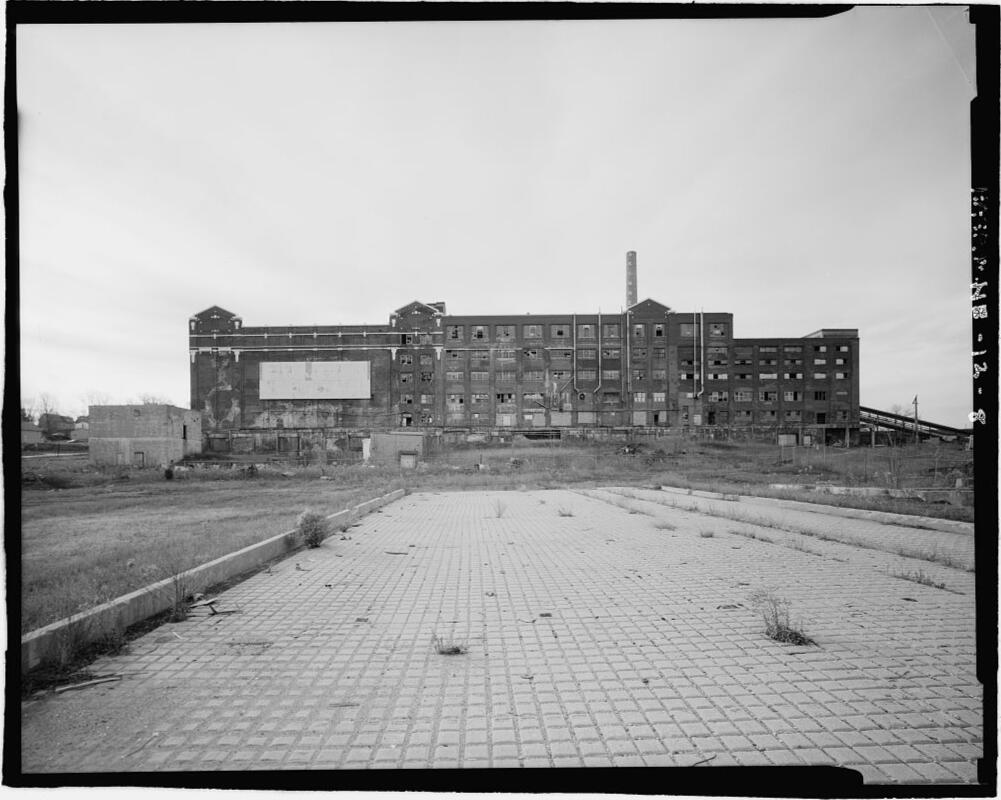
Skinner Meat Packing Plant, 6006 South Twenty-seventh Street, Omaha, Douglas County, NE1, View of main building looking south (concrete in foreground is part of holding pens), Library of Congress Prints and Photographs Division Washington, D.C. 20540 USA
In an industrial slaughterhouse in Omaha, Nebraska, 2,500 cattle are killed every day. Political scientist Timothy Pachirat spent five months working undercover in one such facility and found that of 121 distinct jobs on the kill floor, exactly one worker, called the knocker, finds the animal alive and delivers the killing blow2 (Pachirat, 2011). The other 120 are not the ones who kill. The entire architecture of the building enforces this distribution of moral responsibility. The kill floor is hidden from the offices, "dirty" workers use different entrances than "clean" workers, the facility itself sits in a low-lying warehouse barely visible from the highway.The global system of industrialized animal exploitation runs on a single principle: what is not seen does not need to be justified. Windowless barns, rural locations, manipulation of language and even confiscation of communication as in some organizations ag-gag laws are put in place that criminalize the very act of filming inside factory farms. The infrastructure of invisibility is total, tailor-made. It's a distribution of the sensible3: a system which determines what can be perceived and by whom, what is admitted into the field of collective experience and what is kept outside it (Rancière, 2004). Industrial animal farming exists in a carefully maintained blind spot, and Contamination illuminates what that blind spot contains.Aleksa Mitrović’s project Contamination sources the images which infiltrate this architecture of invisibility: undercover footage from poultry farms, drone shots of mass animal graves, news documentation of ecological catastrophes/human atrocities. These images are low-resolution, compressed, degraded through circulation, scattered across the internet. They are grainy, shaky, badly lit. They are essentially evidence: shot under duress, often illegally, by people risking prosecution to document what the industry spends millions to hide.
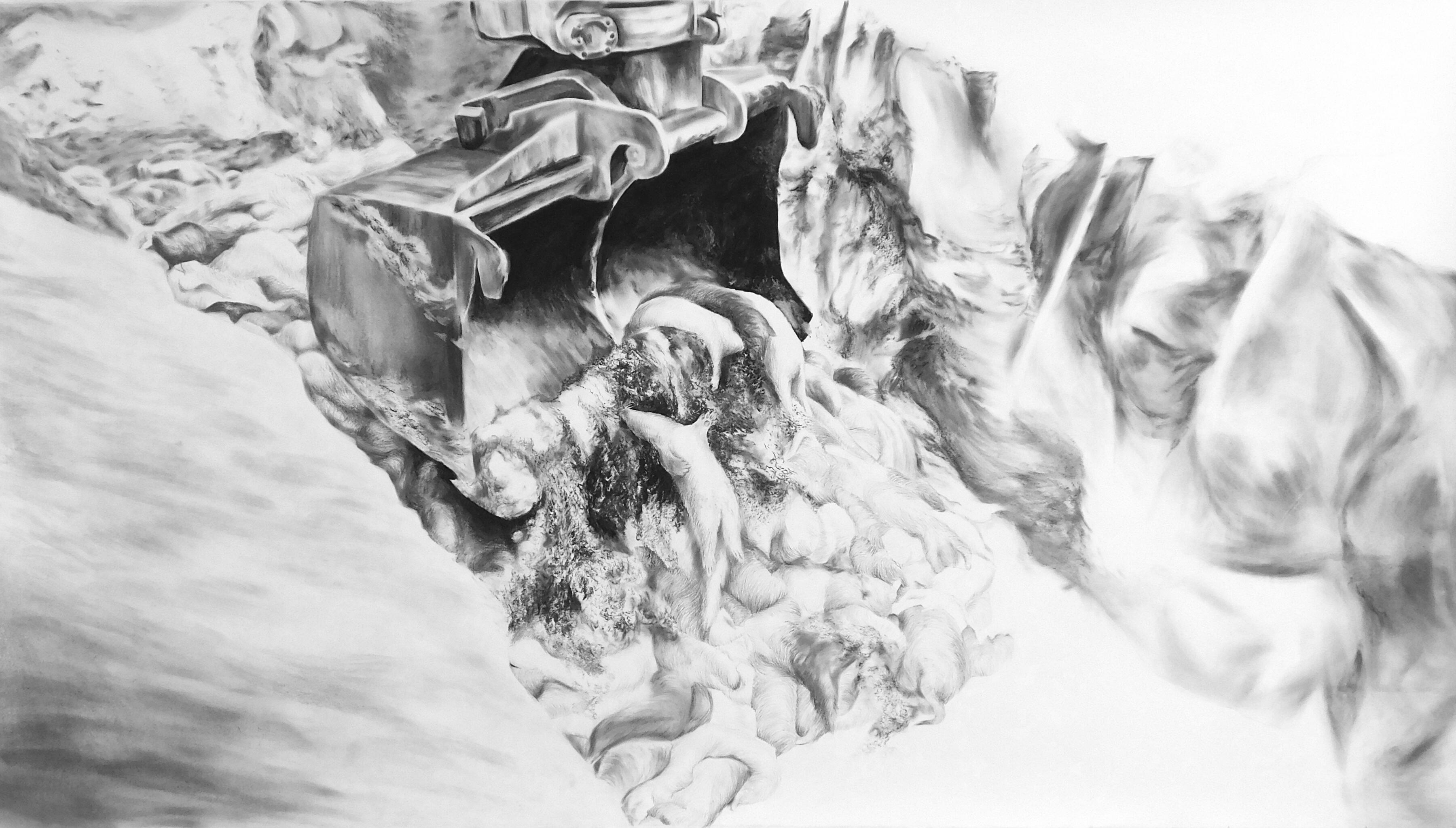
Burial of Minks in a Mass Grave in Denmark, 2020, 2022.
charcoal and graphite on paper, 120x213cm
Mitrović takes these images and translates them into charcoal on paper and oil on canvas, dimensions of which at times exceeding two meters. While the digital is lost in a stream of content, the work demands confrontation. That difference in labor is a difference in attention, which is a difference in ethics.The charcoal works are the backbone of the project as they operate in a visual register that refuses resolution. Burial of Mink in a Mass Grave in Denmark, 2020. does not clarify its source. One sees shapes that could be machinery, could be earth, or bodies, and thousands of bodies, in fact, bulldozed into trenches on military land near Holstebro. The Danish government had ordered the killing of all seventeen million farmed mink in the country after SARS-CoV-2 mutated within the densely packed populations and jumped back to humans, made possible by the conditions of industrial farming: small cages, high densities, immunocompromised animals. When the hastily buried carcasses began pushing back up through the soil weeks later (an event the global press called "zombie mink"), the architecture of concealment had failed, causing an outrage. Contamination holds the viewer within the soil, moments before that failure. The image hovers between abstraction and documentation. You know what you are looking at, yet you cannot entirely see it? This gap between knowing and seeing is where the work lives. In that sense, this project is less epistemological and more ethical. Mitrović is not asking what can we know through images? but what do we already know and choose not to look at? This is art as combatant—even militant—counter-architecture: an instrument built to make visible what another structure was built to hide.
"To maintain my focus on [the articles] and share the information I discovered, I decided to integrate my interest in this topic into my artistic practice."
— Mitrović on conception of Contamination
The structural titles do essential work. Without them, the charcoal drawings could be absorbed as atmospheric abstraction, or anything else that’s safely vague. They specify dates, places, industrial processes and institutional failures. They restore what Carol J. Adams calls the absent referent, the living animal that disappears behind the euphemisms of commodity language. Adams describes a three-step process by which animals vanish: objectification, fragmentation, and finally—consumption. Language finishes the job: “beef“ not “cow“, “pork“ not “pig“. Contamination’s titles reverse this process and reassemble the referent, which creates a productive tension at the heart of the work as the viewer is unable to retreat into pure form and dismiss the subject matter. In Regarding the Pain of Others, Sontag argued that images of suffering serve as an invitation to pay attention, to reflect and to examine the rationalizations for mass suffering offered by established powers, but she also warned that compassion is unstable as it needs to be translated into action, lest it withers4. The tension in Contamination is precisely this: the work creates the conditions for attention but refuses to resolve the question of what shall be done with it.

Suffocation of Chickens with Foam in Israel, 2014, 2021.
charcoal on paper, 70x100cm
Suffocation of Chickens with Foam in Israel, 2014, 2022.
oil on canvas, 70x100cm


The oil paintings function as a counterpoint to the charcoal drawings. They are smaller, more contained, working in color rather than monochrome. The two versions of Suffocation of Chickens with Foam in Israel, 2014—one in charcoal, the other in oil—when placed in dialogue, reveal how the same event registers differently across media. The charcoal immerses you in the event’s atmosphere, its dust and uncertainty (there is a material politics in choosing the lowest-status medium to address the lowest-status subjects), while oil fixes the image in its place, lending it institutional gravity. Together they form something like a dossier, or evidence gathered in two different registers, under two separate media narratives. Once a being is, under separating narratives, rendered as a vague idea, can it be grieved? Judith Butler argues that grievability is the precondition for a life to matter: that without social recognition that a loss would be mourned, a life effectively does not register as life5. The question is always: whose lives count? Whose deaths are grievable? Industrial animals exist as ultimately ungrievable lives which do not matter. Mitrović’s paintings insist that what happened be seen as something that happened to someone, and not something. The refusal to look is not sensitivity, but a privilege of those whose lives are not at stake in the image.The project’s title names a condition, not a theme: a desensitizing slow violence, destruction that occurs gradually and out of sight, not typically viewed as violence at all, created by human hand and conditioned by its need to grow and conquer. Once there is nothing left, it metastasizes, crossing boundaries between species, both in bodily afflictions and emotional experience, previously described as being buried in the soil among the mink carcasses. The images do not leave as they had infiltrated the viewer’s blind spot.Thou shalt not make killable6 (Haraway, 2008). Not a prohibition against all death—living always involves differential dying; but a refusal of a machine for making killable, the terms on which those animals were made to disappear within an architecture of invisibility—is what Contamination is created to subvert, dismantle and ulimately abolish.
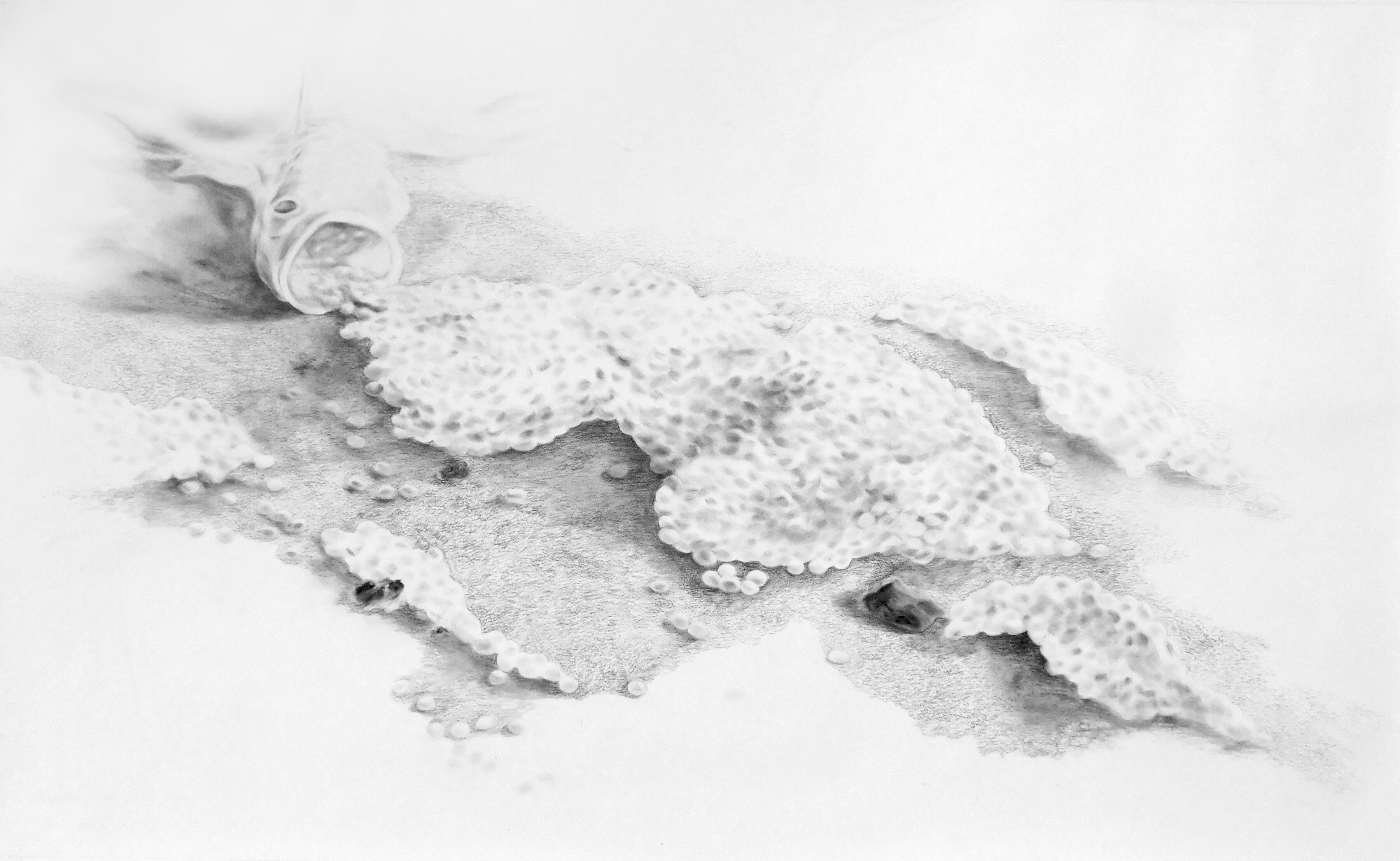
Plastic Pellets on a Beach in Sri Lanka, 2021, 2022.
charcoal and graphite on paper, 100x164cm
Aleksa Mitrović was born in 1999 in Ruma, Serbia. He completed his BA in painting at the Academy of Arts in Novi Sad in the class of Professor Vlada Rančić and his MA at the same institution under Dr. Lidija Marinkov. He is a two-time recipient of the Fund for Young Talents scholarship of the Republic of Serbia, has presented three solo exhibitions, and has participated in over ten group shows.
| Author | Title | Year | Publisher |
|---|---|---|---|
| Butler, Judith | Frames of War: When Is Life Grievable? | 2009 | Verso |
| Haraway, Donna Jeanne | When Species Meet | 2007 | University of Minnesota Press |
| Hirschhorn, Thomas | Why Is It Important—Today—To Show and Look at Images of Destroyed Human Bodies? | 2013 | Institute of Modern Art |
| J. Adams, Carol | The Sexual Politics of Meat: A Feminist-Vegetarian Critical Theory | 1990 | Continuum |
| Pachirat, Timothy | Every Twelve Seconds: Industrialized Slaughter and the Politics of Sight | 2011 | Yale University Press |
| Rancière, Jacques | The Politics of Aesthetics: The Distribution of the Sensible | 2004 | Continuum |
| Sontag, Susan | Regarding the Pain of Others | 2003 | Farrar, Straus and Giroux |
| / | Coronavirus: Denmark to Exhume Millions of Mink from Mass Graves | 2020 | Al Jazeera |
* * *


PERFORMANCE
Two solitudes protect and border and greet each other (or, Waltz)
2022 - Ongoing
Performance
24"Partner in video: Marijana Dragić
Sound engineer, music producer: Kosta Ranđelović
Camera: Ivana Mandić
Waltz is an informal one-on-one performance/research project exploring distance and enforced intimacy between people, presenting a strict intervention into routine. Participants follow randomly generated instructions and are thereby divorced from will, finding refuge in their partner and their shared experience. The fruits of this inevitable experience, traced by biometric sensors which record reactions of the body to stress and solice, then manifest in visual and sonic forms: interpretations of a shared moment dislocated from the joint.
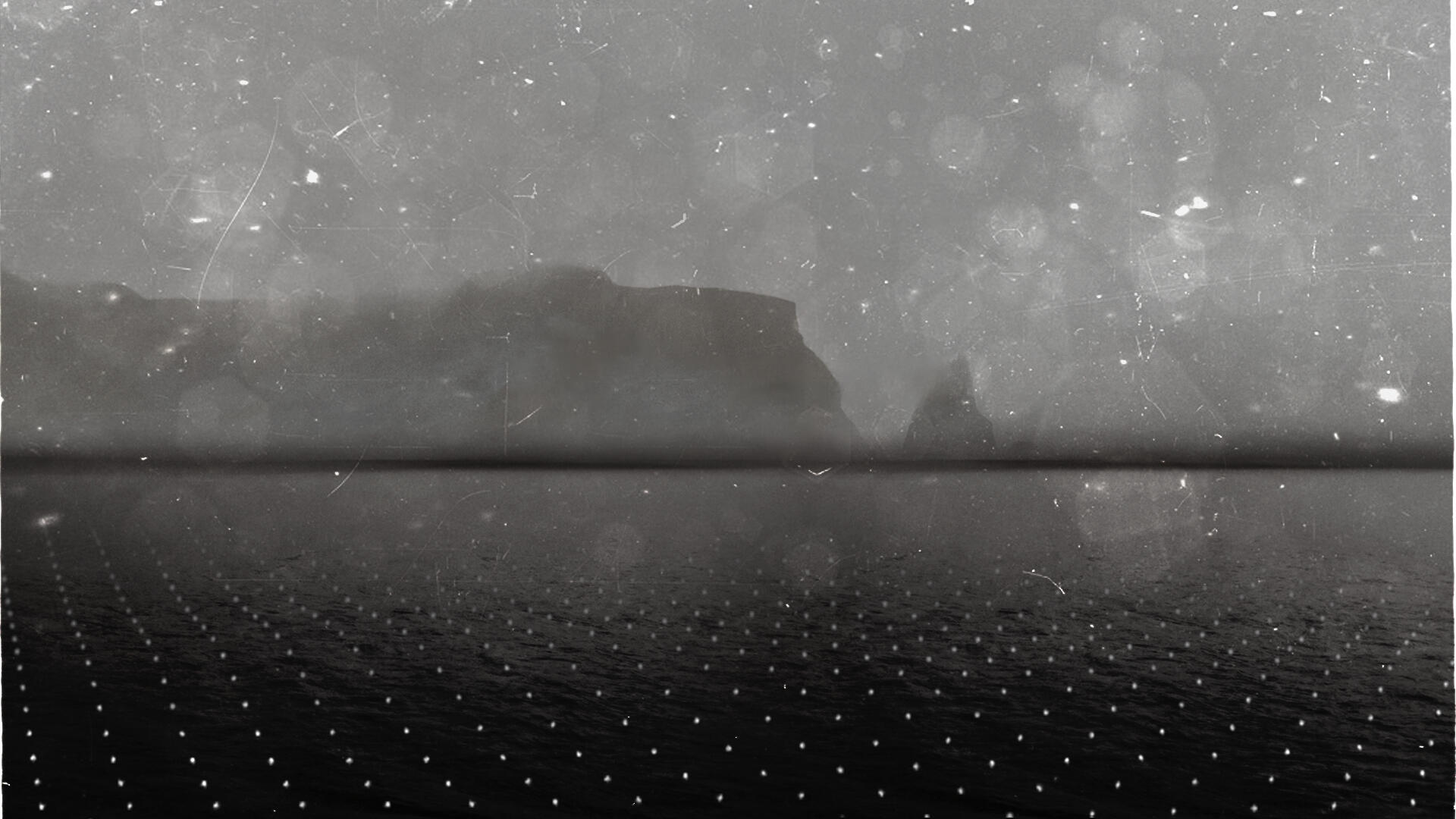
These notions inform Mirror Terrain, an installation within which: images of ancestors, the significant dead, archetypal figures and even past audience. A viewer's reflection enters the three-dimensional space and moves among them. Contact erodes these figures as the they offer no resistance.The eye can be trained to see what is absent. Memory, made tangible, becomes something to navigate, to damage or protect. The work asks what preservation requires: not only remembrance, but attention beyond the present. The act of turning toward what is absent cultivates resilience as the random compositions of figures reveal scenes of families, communities and relationships in a shared, absolute flow.
COMBINED
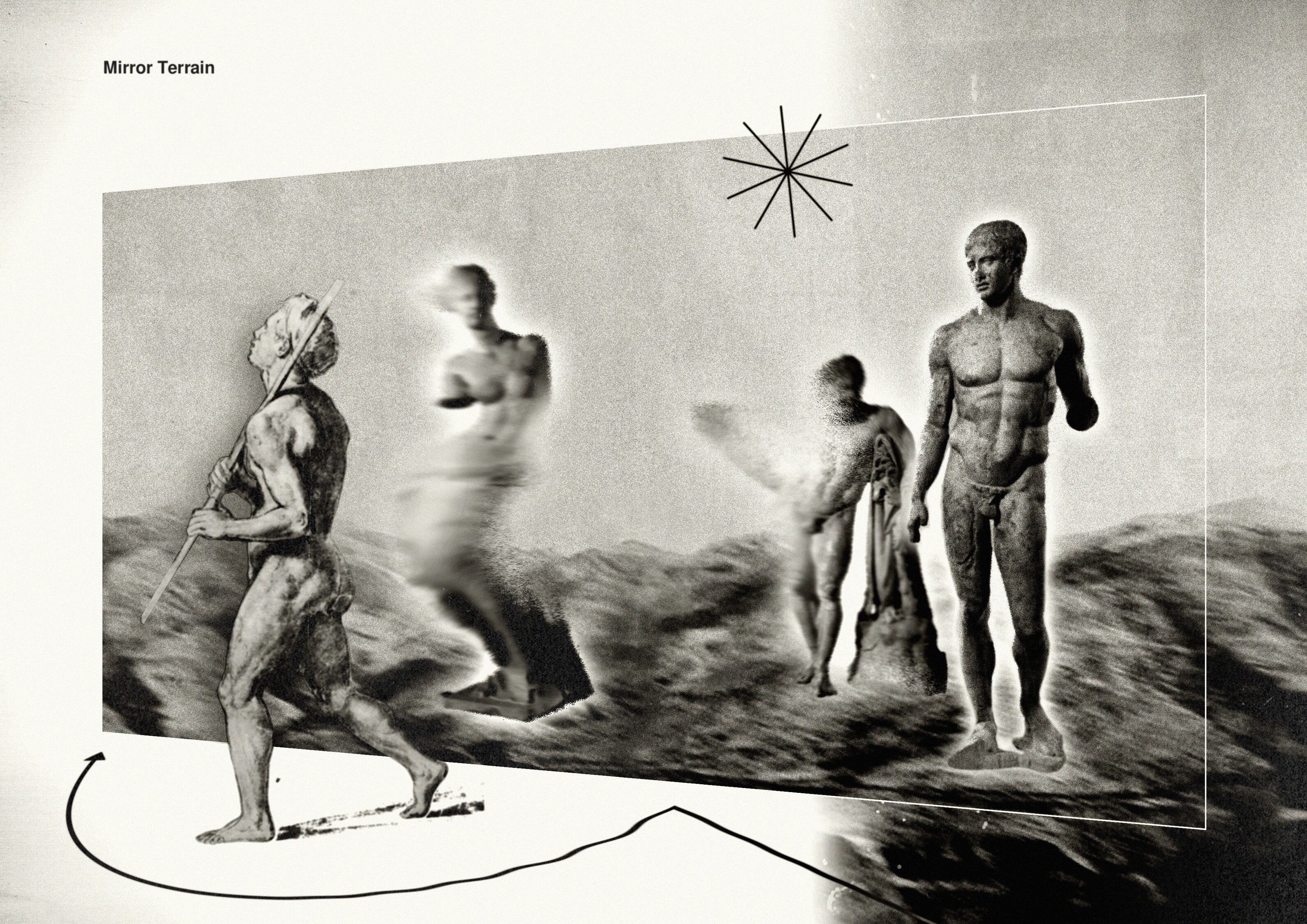
Sacred Objects & Minor Deaths (or, Angelorum)
Presented at Ars Electronica 2022
Interactive installation
Variable dimensions
“Memory is not an instrument for surveying the past but its theater. It is the medium of past experience, as the ground is the medium in which dead cities lie interred.”
— Walter Benjamin, Berlin Childhood around 1900
1 Published in a 1905 Russian publication titled "V.M Doroshevich East and War" by journalist Vlas Mikhailovich Doroshevich.Indian students faced intense pressure in the early colonial period, when Western-style university education (introduced by the British) was seen as one of the few paths to civil service positions and social advancement.
2 Waiting for God is a collection of Weil's letters and essays written during her final years, documenting her radical spiritual philosophy while refusing institutional religion. Weil argues that genuine prayer is not petition but pure attention: a complete openness to reality that requires us to "decreate" ourselves, to undo our ego's constant manufacturing of meaning and become transparent vessels for divine love. She insists we must consent to necessity, to the world's weight and affliction, without consolation or escape into fantasy; only through this absolute acceptance of reality (including suffering) can grace enter.The "waiting" in her title isn't passive but an active discipline of attention without grasping, learning to love without possessing, to believe without joining, to create without claiming authorship... What she calls becoming "impersonal" enough that God's love can pass through us toward the world, making us instruments rather than owners of truth.
ESSAY
Light, Otherwise
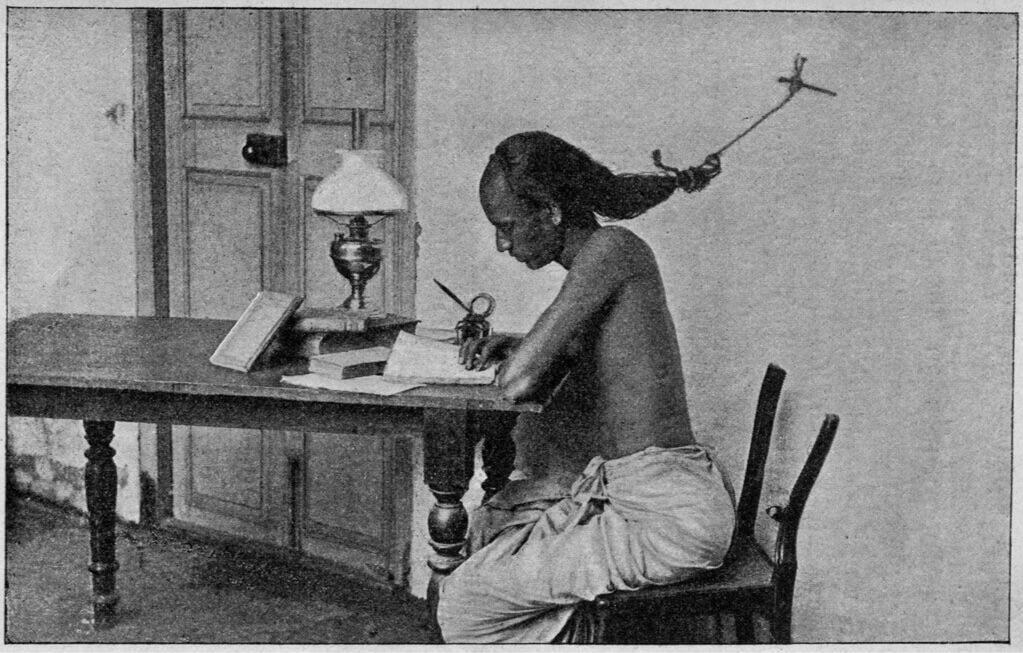
University of Madras student ties his hair to nail to prevent sleeping at night while preparing for exams, 1905. 1
Simone Weil understood prayer as attention without object, a discipline of receptivity that unmakes the one who attends. In the Renault factory, with hands bloodied by metal sheets, she discovered that repetitive labor could become contemplation; not transcendence, but a descent into matter's opacity where light enters through fracture (that's right - God's in the factory, not the cathedral!).This is the path we trace: the artist's work as what Weil called "consent to necessity". Not the romantic myth of inspiration, but something more severe and tender: Paul Celan writing after Auschwitz, each poem a "message in a bottle" thrown toward an addressee who may not exist. Agnes Martin drawing the same line ten thousand times until personality dissolves into vibration. Ann Demeulemeester working through the same black thread drawn through fabric thousands of times, rendering the shadow not as absence but as light's most honest form ("white shadows", she calls them). Theresa Hak Kyung Cha in Dictee, fragmenting language itself to speak to displacement, each broken sentence in reverence to that which cannot be made whole. Patti Smith dissolving into rhythm as incantatory repetitions ("go Rimbaud - go Rimbaud go - Rimbaud") become decreative practice, until something else speaks through. Tarkovsky flooding a house to film memory's architecture, waiting hours for the light to move across water… This is prayer as pure expenditure, creation that refuses the economy of recognition.
“The quality of the attention counts for much in the quality of the prayer. Warmth of heart cannot make up for it.”
— Simone Weil, Waiting on God 2
When Weil writes that beauty is "a trap set by God to make the soul consent to receive him," she reveals creativity's violence: how it demands we be wounded by reality before we can witness it. The artist becomes a nail whose head alone stops the violin string from vibrating. Minimum presence, maximum disruption. Light, Otherwise proposes that genuine creative practice operates through what Weil termed "supernatural use of suffering": not suffering's glorification but its transformation through attention into aperture. Every creative act performs this paradox: to make something that unmakes the maker, to produce presence through practiced absence. We are not speaking of quietism or withdrawal - Weil died of tuberculosis aggravated by refusing food in solidarity with occupied France, her attention was militantly material. So too with creation: it must engage matter's full resistance, must know the weight of pigment, the stubbornness of language, the way film emulsion holds and releases light, and ultimately recognize its place in the world, alongside mankind's grandeur and catastrophe.To speak only of what leaves you speechless - this is the parallel prayer, each attempt running alongside others without convergence. Not communication but communion. The light enters otherwise, not through sovereignty but through the cracks it leaves when it fails.
| Title | Author | Year | ISBN |
|---|---|---|---|
| Neuromancer | William Gibson | 1984 | 0-441-56956-0 |
| Snow Crash | Neal Stephenson | 1992 | 0-553-08853-X |
| Software | Rudy Rucker | 1982 | 0-441-77408-3 |

Suffocation of Chickens with Foam in Israel, 2014, 2021.
charcoal on paper, 70x100cm
Suffocation of Chickens with Foam in Israel, 2014, 2022.
oil on canvas, 70x100cm